Cost vs Safety: Why Investing in Explosion-Proof Aerial Lifts Saves Money Long-Term
January 31, 2026
In hazardous operating environments, buyers rarely debate whether safety matters. The real discussion tends to surface around cost, timelines, and how much risk an operation is willing to carry forward. Over time, many teams discover that framing the decision as cost versus safety oversimplifies what is actually at stake.
What often emerges instead is a deeper question about predictability. Upfront equipment costs are known and measurable. The downstream consequences of using equipment not designed for hazardous conditions are not. This shift in perspective is why conversations around hazardous area aerial lifts increasingly focus on long-term exposure rather than initial savings.
For organizations navigating these environments, explosion-proof aerial lifts are less about meeting a safety expectation and more about managing uncertainty across operations.
Challenges Of Lower-cost Explosion-Proof Aerial Lifts
Lower-cost access equipment can appear financially efficient at the time of purchase. The explosion proof lift price is lower, procurement cycles move quickly, and the decision feels contained. Over time, however, several recurring challenges tend to surface:
Downtime risk
Equipment that is not fully aligned with hazardous area requirements is more likely to be flagged during audits or site inspections, leading to temporary shutdowns and operational delays.
Emergency replacements
When compliance issues arise mid-project, teams often turn to short-notice rentals or replacements, introducing unbudgeted costs and logistical complexity.
Investigation overhead
Even minor events can trigger investigations, corrective actions, and reporting requirements that divert time and resources away from core operations.
Schedule disruption
Delays caused by equipment limitations frequently ripple through schedules, affecting labor planning, contractor coordination, and delivery commitments.
Decision Framework: When Higher Upfront Cost Is the Smarter Choice
Whether it’s an explosion-proof boom lift or scissor lift, operations in hazardous environments often reach stronger conclusions by stepping back from price comparisons and focusing on operating conditions. The following questions help clarify whether investment in compliant equipment aligns with business priorities:
Is the work environment classified as hazardous or subject to evolving compliance standards?
Does the organization prioritize predictable operating costs over short-term savings?
When the answer trends toward yes, the decision often moves beyond cost minimization. In these scenarios, engaging experienced explosion-proof lift manufacturers and selecting equipment designed for hazardous use supports both operational continuity and internal risk management.
How Explosion-Proof Aerial Lifts Control Long-Term Cost Exposure
As equipment moves from evaluation to daily use, long-term costs tend to surface in areas that are rarely captured during initial price comparisons. In hazardous environments, explosion-proof aerial lifts help contain this exposure by addressing risk at the design level rather than through reactive controls.
is less likely to be flagged during audits or inspections, allowing work to continue without interruption.
Incident cost containment
By minimizing ignition risk, compliant equipment strengthens explosion proof lift safety and reduces the likelihood of incidents that lead to investigations, corrective actions, and associated labor costs.
Operational continuity
Teams can plan work schedules with greater confidence when hazardous area aerial lifts align with site classifications from the outset.
Maintenance predictability
Purpose-built systems used across explosion proof scissor lifts and other access platforms tend to follow more stable maintenance cycles, reducing unexpected servicing and replacement events.
Lifecycle stability
Across their working life, EX proof aerial lifts shift costs from unpredictable operational events to a controlled, planned investment, reinforcing the broader explosion proof lift investment benefits for hazardous operations.
Bailey Cranes’ Approach to Explosion-Proof Aerial Lifts
Bailey Cranes is a specialty engineering and manufacturing company in the USA, focused on designing and retrofitting access equipment for hazardous environments. As one of the established explosion-proof lift manufacturers, the company prefers compliance, reliability, and lifecycle stability in environments where uncertainty carries operational and financial consequences.
Bailey Cranes doesn’t focus on the lower or higher price of equipment; the team focuses mainly on the right price without compromising the quality of explosion proof lifts or any other machines.
What Sets Bailey Cranes Apart:
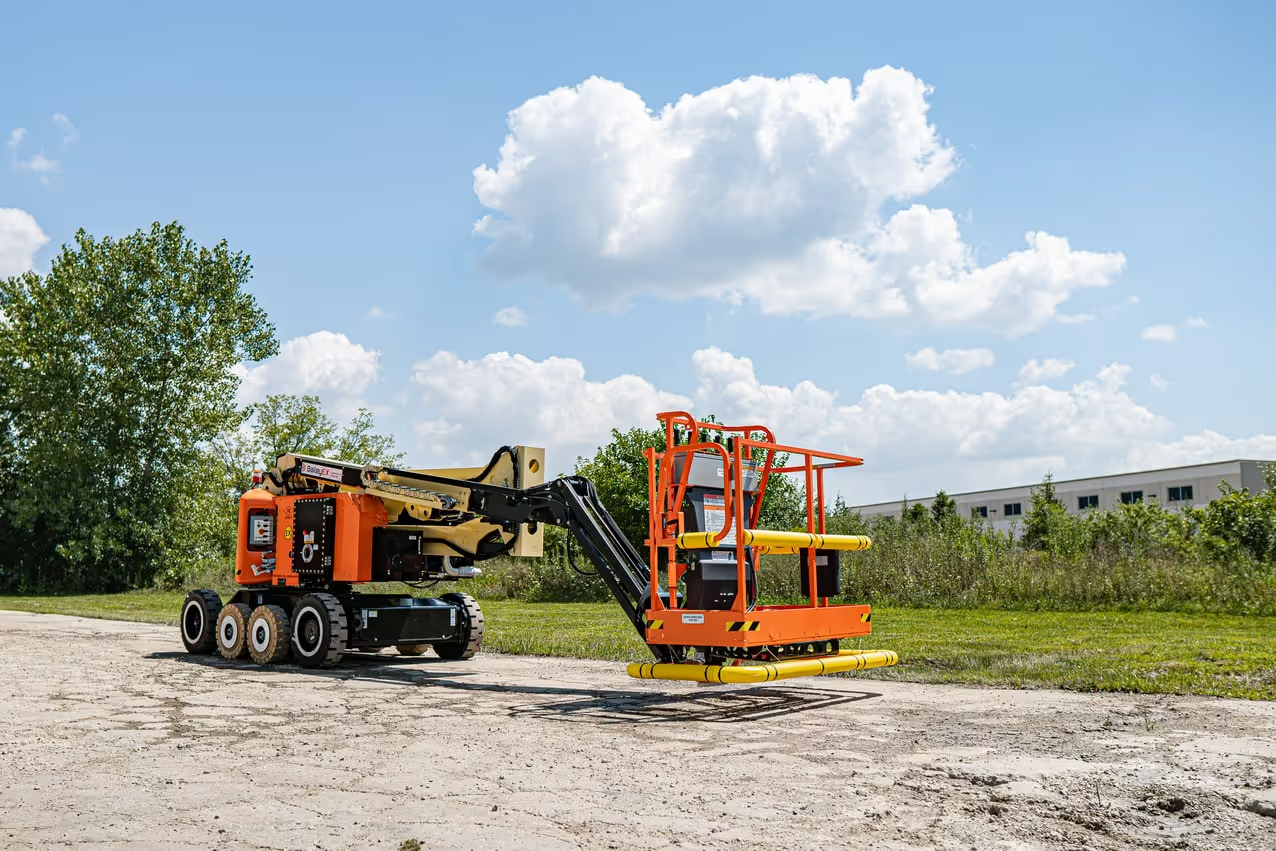
Designs solutions through strategic retrofitting of proven platforms or custom engineering when site conditions demand it.
Engineers EX-rated aerial work platforms to meet current ANSI A92.20 standards and FM Class requirements.
Simplifies hydraulic systems to reduce leak points and limit maintenance variability over time.
Integrates load-sensing and control systems that support stable operation in hazardous conditions.
Selects EX-rated electrical components specifically designed for hazardous locations, reinforcing explosion proof lift safety.
Focuses on predictable performance and durability, contributing to long-term explosion proof lift investment benefits.
What Should Operations Teams and Equipment Buyers Do Next?
To reduce long-term exposure in hazardous environments, teams need to move beyond surface-level price comparisons and adopt a more structured approach to access equipment decisions. A few focused actions can help bring greater clarity and control to the process:
Review access equipment choices using total lifecycle impact rather than upfront explosion proof lift price.
Evaluate how well equipment specifications align with hazardous area classifications and inspection requirements.
Assess the operational impact of downtime, rescheduling, and compliance-related interruptions.
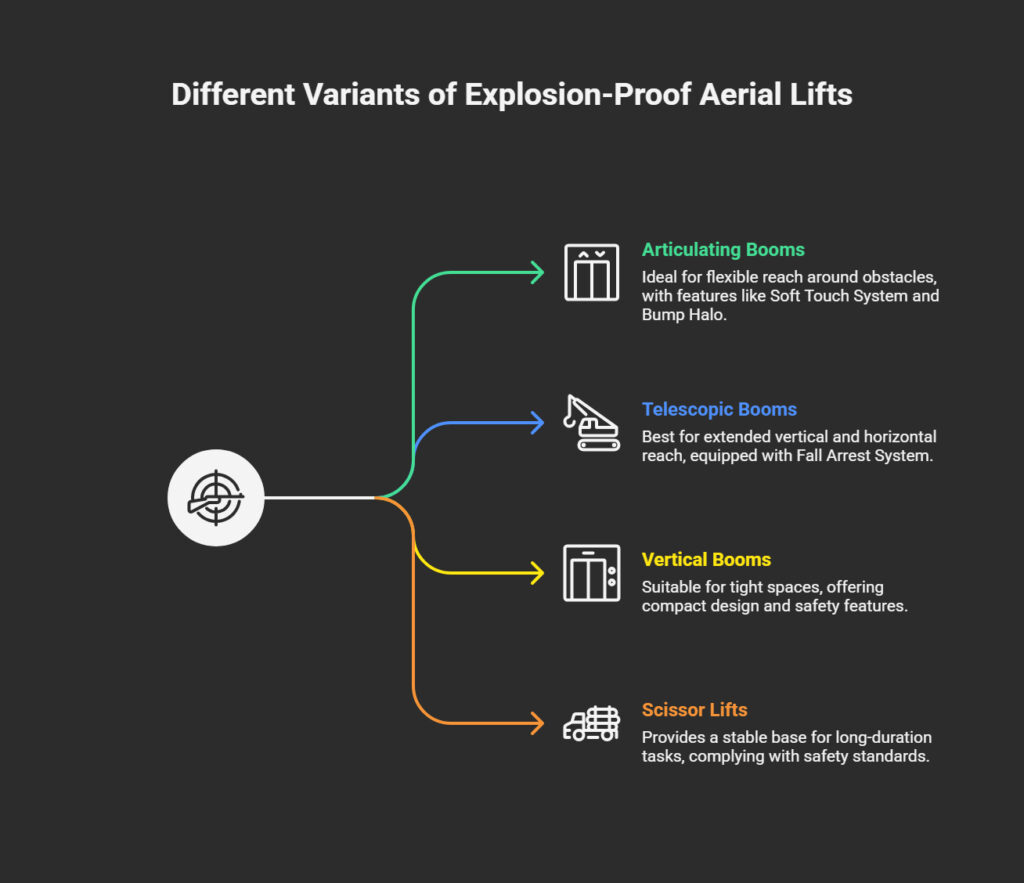
Prioritize platforms designed specifically for hazardous use, including explosion-proof boom lifts and explosion proof scissor lifts.
Work with experienced explosion-proof lift manufacturers like Bailey Cranes that support long-term performance and service consistency.
Investment in compliant access equipment is less about absorbing higher upfront costs and more about establishing long-term stability; reducing that uncertainty is often the most meaningful outcome of all. To learn more about our lifting solutions, contact Bailey Cranes at 262-710-4028 or email us at sales@baileycranes.com.
Ready to lift your service?
Contact our sales team to see how we can build out a custom design for your application today.
Partner with Bailey to transform proven platforms or build fully custom lifting solutions—engineered, manufactured, and supported under one roof for mission-critical environments where failure is not an option.
Bailey Specialty Cranes & Aerials is a Service-Disabled Veteran-Owned engineering and manufacturing firm based in Muskego, Wisconsin. We specialize in precision access solutions for industries where the margin for error is zero.


.avif)