.avif)

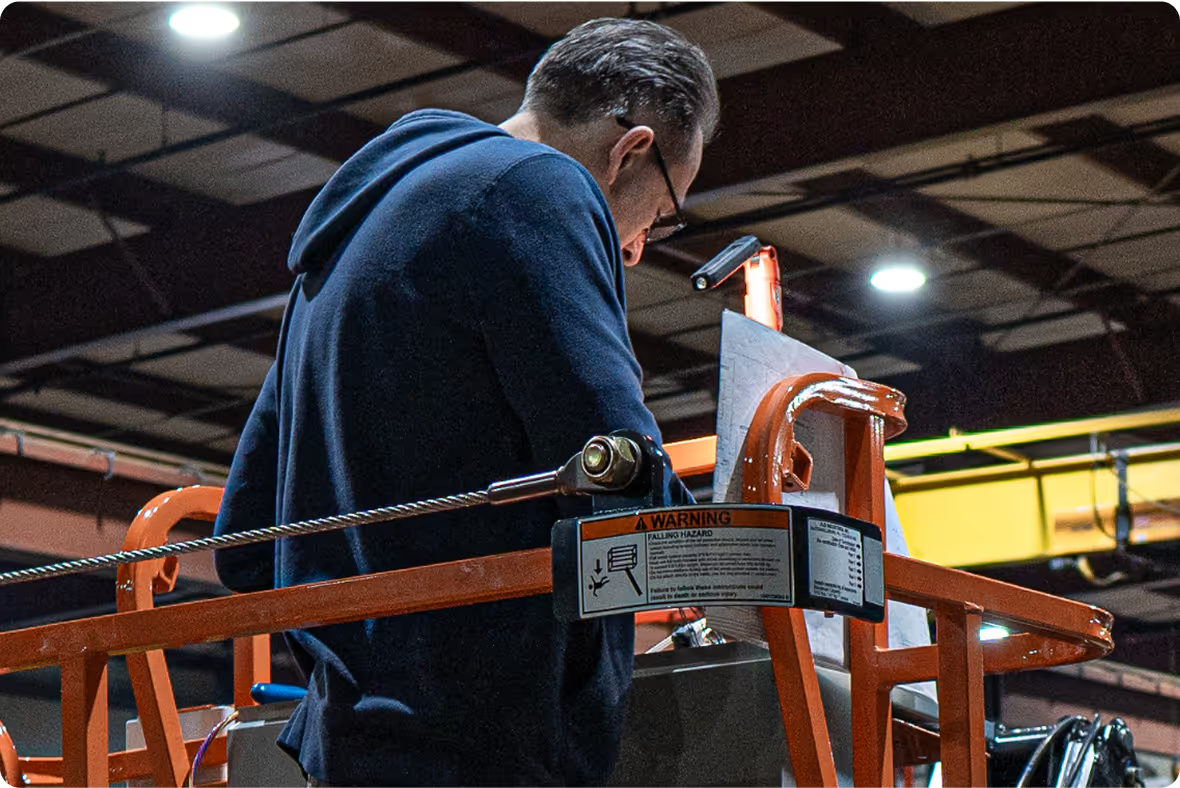



In a standard warehouse, a scissor lift is just a tool. In a chemical plant, a paint hangar, or a grain processing facility, the wrong lift can be an ignition source. Explosion-proof man lifts are engineered to eliminate the sparks, arcs, and heat signatures that standard aerial work platforms produce as a normal part of operation. When flammable gases, vapors, or combustible dust are present in the air — even intermittently — that engineering difference is the line between safe operation and a catastrophic incident.

What Makes a Lift "Explosion-Proof"?
The term "explosion-proof" in the context of electrical equipment has a specific technical meaning defined by the National Electrical Code (NEC) and enforced through third-party certification by bodies like FM Approvals and UL.
An explosion-proof man lift is not simply a lift with additional guarding. It is a machine where every electrical component — motors, controls, wiring, switches, indicators, and connectors — has been redesigned or enclosed to prevent ignition of the surrounding atmosphere. This involves:
Sealed Enclosures
Electrical components are housed in enclosures that contain any internal arc or spark, preventing it from reaching the surrounding atmosphere.
Non-Sparking Materials
Exposed structural and contact surfaces use materials that do not produce sparks on impact or friction.
Shielded Wiring
Metal-shielded cabling replaces standard insulated wire, eliminating arc paths along all cable runs. Bailey uses NFPA/NEC 70-compliant shielded cable throughout.
Temperature Class Compliance
All components are rated to ensure their surface temperature cannot reach the ignition point of the surrounding atmosphere under any operating condition.
Third-Party Certification
The complete machine — not just individual components — must be tested and certified by an NRTL such as FM Approvals. Component-level claims are not enough.
Without all of these elements, a lift is not truly explosion-proof — regardless of what the sales sheet says.
Understanding NEC Hazardous Location Classifications
Before specifying explosion-proof equipment, you need to know your facility's NEC classification. This determines the certification level your equipment must carry.
Flammable Gases & Vapors
Chemical plants, oil refineries, aerospace paint hangars, fuel storage areas.
Combustible Dust
Grain elevators, flour mills, battery manufacturing, pharmaceutical production.
Ignitable Fibers & Flyings
Textile mills, woodworking facilities, fiber processing environments.
Bailey EX Series lifts are certified for Class I, Division 1 environments — the most demanding classification, covering facilities where hazardous concentrations exist during normal operations. This certification also satisfies Division 2 and Zones 1 and 2 requirements.

Industries That Require Explosion-Proof Man Lifts
Aerospace Paint Hangars
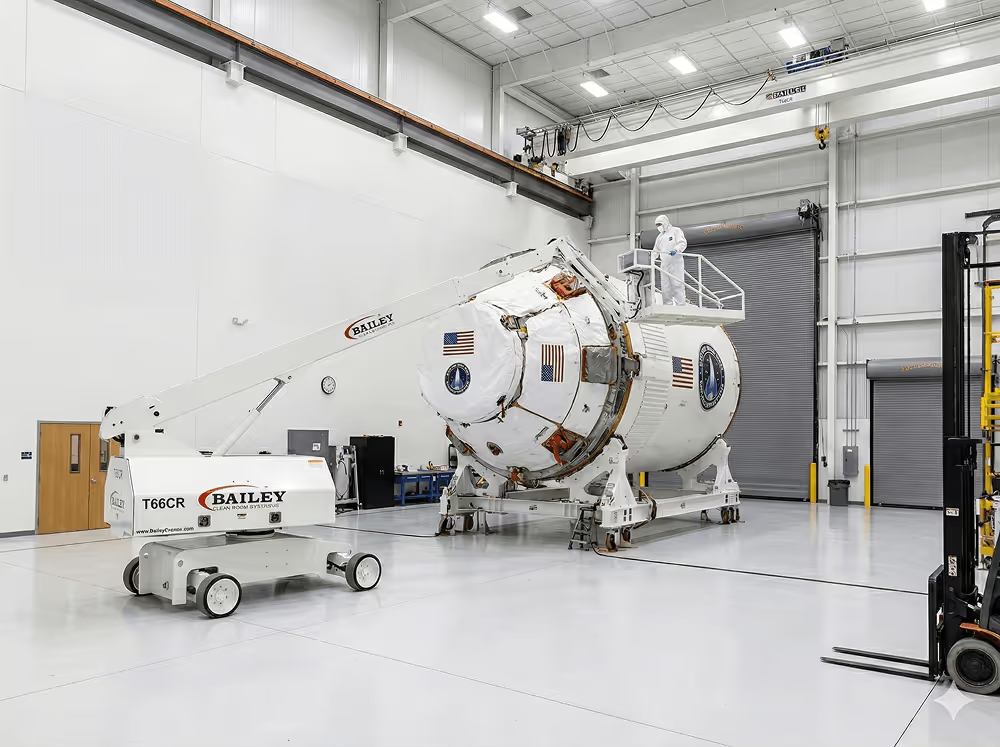
Aircraft painting involves significant concentrations of flammable solvents and propellants. The U.S. Air Force, Boeing, Lockheed Martin, and NASA all require Class I, Div. 1 certified equipment for personnel in or near paint booths.
Chemical Processing Plants
Ongoing presence of flammable gases and vapors makes Division 1 certification mandatory for virtually any powered equipment in process areas.
Petroleum & Refinery Operations
Tank farms, loading facilities, and processing areas involve continuous exposure to flammable hydrocarbon vapors. EX-rated lifts are required for any maintenance or inspection access in these zones.
Pharmaceutical Manufacturing
Solvent-based processes including extraction and coating operations create temporary or continuous Class I atmospheres. EX lifts are increasingly specified across these environments.
Battery Manufacturing
Lithium-ion and lead-acid battery production generates hydrogen gas during charging cycles. Class I, Div. 1 certification is required for powered equipment in charging and formation areas.
Grain, Feed & Food Processing
Combustible dust from grain, flour, sugar, and starch creates Class II explosion hazards — among the most frequently overlooked hazardous locations in U.S. industry.
MRO Facilities (Aviation)
Fuel systems, hydraulic fluids, cleaning solvents, and degreasers create both Class I and Class II hazards during routine aircraft maintenance. A spark from a non-rated lift can initiate an incident during what seems like a routine inspection.

What Standard Lifts Get Wrong in Hazardous Locations
Using a non-rated lift in a hazardous location is not just a compliance risk — it is a genuine safety hazard. Here is where standard aerial work platforms create ignition potential:
- Relay Sparks: Standard motor controllers use contactors that produce small arcs during switching. In a flammable atmosphere, these arcs can initiate ignition.
- Motor Brushes: Many standard motors use carbon brushes that produce sparks during normal operation. Explosion-proof motors are brushless and sealed.
- Unshielded Wiring: Standard cable insulation can arc when damaged. Shielded cabling contains any arc within the cable jacket.
- Battery Venting: Standard lead-acid batteries vent hydrogen gas during charging. EX battery systems are sealed and vented safely away from the operator zone.
- Static Discharge: Standard wheel materials and drive systems can accumulate and discharge static electricity. EX-rated lifts use anti-static materials and grounding systems throughout.
- Hot Surfaces: Standard motors and controllers can reach temperatures that would ignite specific gases or vapors. EX-rated components are tested and rated to remain below ignition temperatures under all operating conditions.
Key Differences: Bailey EX Series vs. Standard Lifts
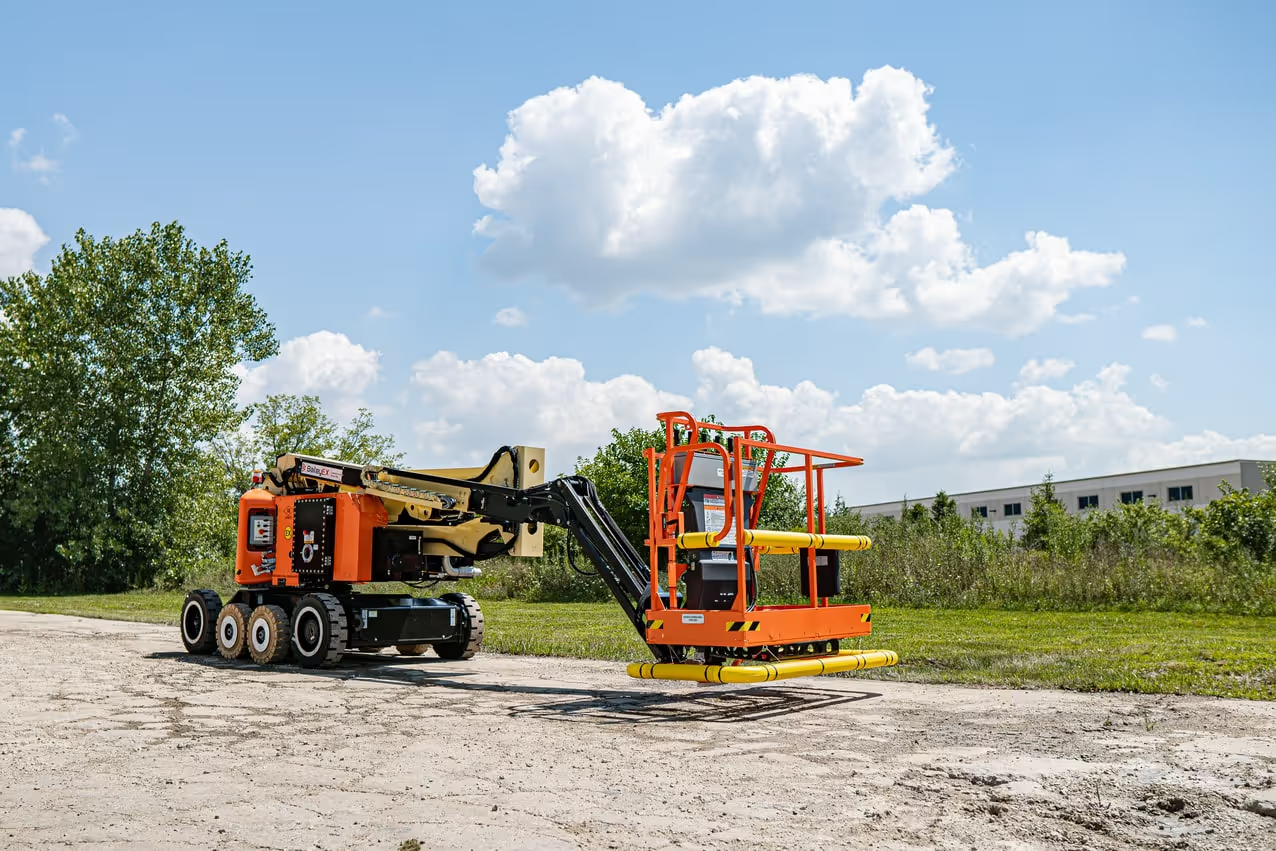
Bailey Cranes developed the original EX Series explosion-proof lifts in 2002. Our team held committee positions on ANSI A92.5, ANSI A92.6, NFPA 505, and UL 583 — we helped write the standards. Here is what distinguishes our EX equipment from both standard lifts and competitor explosion-proof offerings:
-
Electric Joystick Controls — Not Hydraulic
Most competitors still use hydraulic joystick systems requiring over 27 hoses and 38 fittings routed through the machine. These hoses are both a maintenance burden and a failure point in chemically aggressive environments. Bailey's EX lifts use electric joysticks, eliminating these hose runs entirely.
-
NFPA/NEC 70-Compliant Shielded Cabling
We use metal-shielded cable throughout — not the SOOW rubber-shielded cable that many competitors still specify. This is a safety difference, not just a compliance checkbox.
-
Platform-Level Battery Indicator
On most competitor lifts, battery condition is only visible at ground level. Bailey's EX lifts display battery status on the platform via a color-coded LED system (green/yellow/red) — operators always know their operational window without descending.
-
Circuit Breakers Instead of Glass Fuses
Glass fuses are a maintenance hassle and a safety risk in hazardous locations. Our EX Series uses circuit breakers throughout, allowing fast, tool-free resets in the field.
-
Enhanced Motor Management System
Our EX lifts include a motor management system that prevents low-battery contactor flutter — a condition causing premature contactor failure and unpredictable lift behavior on competitor equipment.
-
FM Approved Certification
All Bailey EX equipment carries FM Approval — the most recognized third-party hazardous location certification in North American industrial markets.
EX Series Product Overview
| Model | Type | Max Height | Capacity | Key Feature |
|---|---|---|---|---|
| A80JEX | Telescopic Boom | 86 ft / 26.2 m | 500 lbs | 180° platform rotation |
| T80EX | Articulating Boom | 86 ft / 26.2 m | 1,000 lbs | Articulating + telescoping reach |
| MVL20EX | Vertical Mast | 25 ft / 7.6 m | 350 lbs | Compact footprint for confined spaces |
| 3247EX | Scissor Lift | 32 ft | 500 lbs | Omni-Drive option available |
| 4392EX | Scissor Lift | 43 ft | 500 lbs | High-reach indoor hazardous locations |
Additional variants available for high-capacity work, coal mining, and pedestal-mounted installations. Contact Bailey Cranes for configuration options.
Frequently Asked Questions
What is the difference between explosion-proof and intrinsically safe?
Explosion-proof equipment contains any internal ignition within an enclosure rated to withstand that event. Intrinsically safe equipment limits electrical energy so that even a fault cannot produce a spark sufficient to ignite the surrounding atmosphere. Intrinsically safe ratings are common for instrumentation; explosion-proof ratings are required for motors, drives, and aerial lift equipment.
Can I rent explosion-proof lifts?
Some regional rental markets carry EX-rated equipment, but availability is limited and rental units may not carry the specific certification level your facility requires. For recurring hazardous location access needs, ownership typically offers better total cost and guaranteed specification compliance.
Do I need explosion-proof lifts for the entire facility, or just certain zones?
NEC classification applies zone-by-zone. Areas outside the classified boundary can use standard equipment. Your facility's electrical engineer or safety officer should have a hazardous area classification drawing. If you don't have one, developing that drawing is worth doing before specifying equipment.
How do I verify that a lift is genuinely explosion-proof?
Ask for the FM Approval or UL certification number and look it up in the certifying body's product directory. The certification should specify the class, division, and group for which the equipment is rated. Be skeptical of claims not backed by a verifiable third-party certification number — the difference matters.

Work Safely in Any Hazardous Location
Bailey EX Series lifts are trusted by the U.S. Air Force, NASA, Boeing, and L3Harris. Whether you're specifying new equipment or reviewing existing lifts for compliance, our engineering team can evaluate your NEC classification, confirm certification requirements, and identify the right machine for your application.